The Deployment Mess: How RAG Became the Broken Link in Enterprise AI
By James W. Kim
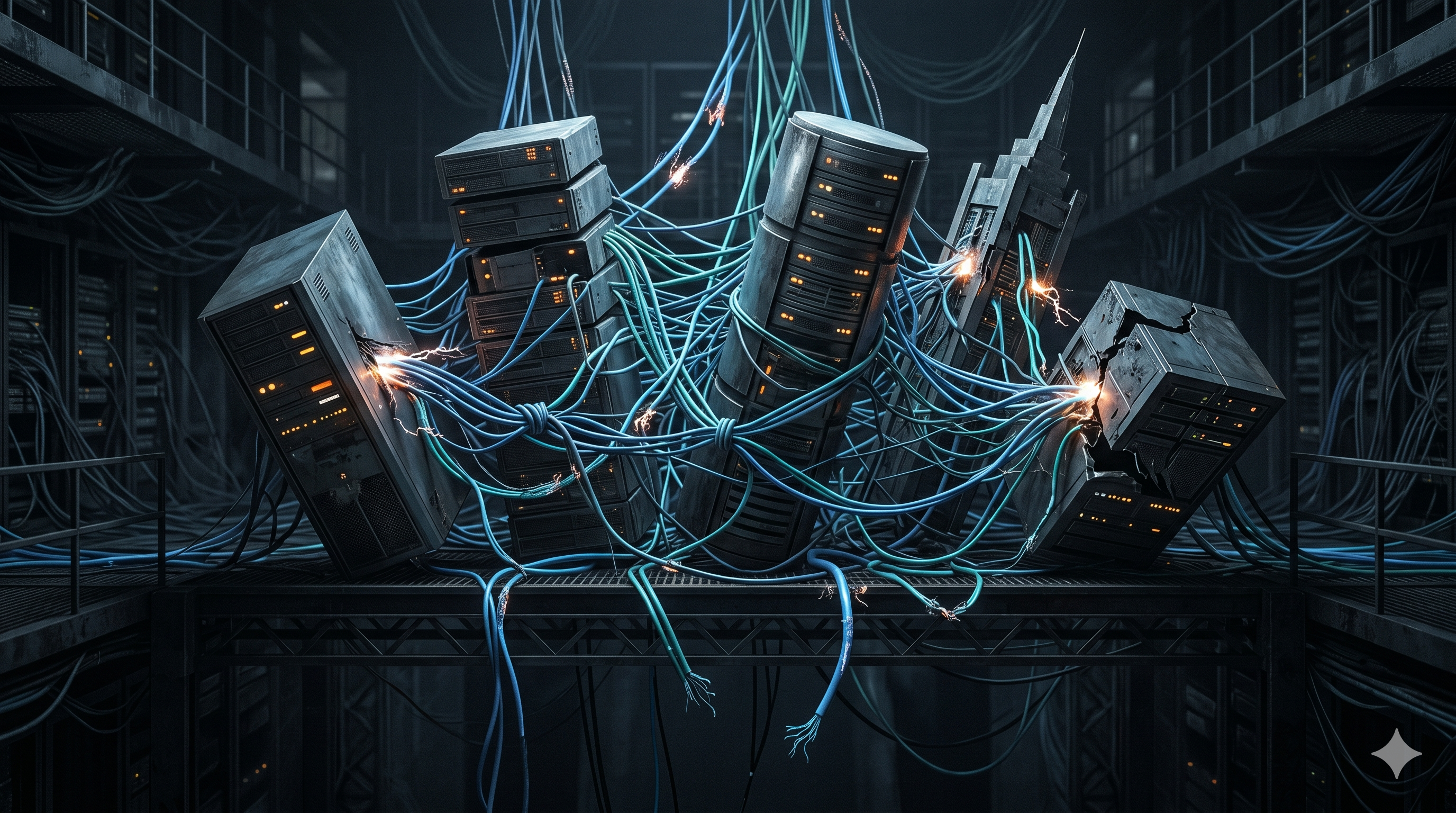
Most enterprise RAG deployments hit a wall. Usually two.
The first is quality — retrieval accuracy that degrades silently as the corpus grows, multi-hop reasoning that doesn’t work, hallucinations that persist despite retrieval. We’ll address that in a future article.
This article is about the second wall: the deployment mess. Not the difficulty of building a demo — that’s a solved problem. The difficulty of running retrieval infrastructure at production scale without it collapsing under its own complexity.
The JBOD (Just a Bunch Of Databases) Mess
The architecture running in most enterprise RAG deployments looks something like this: a vector database for embeddings, a graph database for relationships, a SQL warehouse for metadata, a cache layer for repeat queries, and an orchestration framework stitching them together. Five databases. Five query languages. Five consistency models. Five points of failure.
Steven Dickens, VP at HyperFRAME Research, put it bluntly in a March 2026 VentureBeat interview: “Data teams are exhausted by fragmentation fatigue. Managing a separate vector store, graph database and relational system just to power one agent is a DevOps nightmare.” VentureBeat’s own Q1 2026 Pulse data showed custom stacks rising to 35.6% of enterprise RAG deployments, not because teams love building from scratch, but because no single vendor solves the problem without introducing three more dependencies.
The result: 72% to 80% of enterprise RAG implementations fail to reach production (FalkorDB, 2026). A VentureBeat survey found that 22.2% of qualified enterprise respondents had abandoned production RAG entirely by March 2026, up from 8.6% in January. The abandonment rate is accelerating, not decelerating.
This matters because RAG is the infrastructure layer between the LLM and enterprise data. When retrieval fails, everything above it - the model, the application, the workflow - delivers wrong answers regardless of model quality. You can deploy GPT-5. If retrieval returns the wrong context, the answer is wrong. RAG is not the only reason enterprise AI struggles to deliver value, but it is a necessary condition. Without working retrieval, the rest of the stack is an expensive text generator.
The Multi-Hop Problem Makes the Mess Worse
The queries that would actually unlock enterprise value - those tracing a regulatory chain across five source documents, connecting an adverse event to a supplier to an ingredient to a pending submission etc. - require multi-hop reasoning: retrieval that chains across multiple documents, passages and relationships, not just finding the single most similar document.
Standard vector RAG cannot do this. BM25 keyword search cannot do this. These are single-hop systems. They find individual passages. They do not chain reasoning across them. For simple lookups like “what is the dosing guidance for Drug X?” this is sufficient. For the complex questions that justify an enterprise AI investment, it is not.
The systems designed for multi-hop, e.g. Microsoft GraphRAG, HippoRAG 2, PropRAG, CoRAG etc. add capabilities but also add infrastructure layers. GraphRAG requires entity extraction, community detection, and hierarchical summarization at ingestion, plus LLM calls at query time (20-50 per query for Global Search). HippoRAG 2 and PropRAG add knowledge graph construction on top of vector embedding. CoRAG adds iterative LLM-driven sub-query retrieval. Each additional capability adds another database, another model to serve, another API to maintain, another failure mode to monitor.
The enterprises that need multi-hop most are the ones least able to absorb this complexity. Pharmaceutical regulatory compliance requires tracing drug-target-disease-regulation chains across siloed document systems. But each hop adds latency, inconsistency, and output quality degradation (Fluree, April 2025). The average cost per pharma compliance violation reached $14.8 million in 2024 (FDA enforcement data). Financial services, which is the largest RAG market segment by end user (MarketsandMarkets, 2025), must cross-reference regulations across jurisdictions with full audit trails. These industries face the highest penalty for retrieval failure and the most complex retrieval requirements simultaneously.
The current market offers them two options: simple retrieval that’s easy to deploy but can’t answer their hard questions, or capable retrieval that buries their infrastructure teams under a five-database stack they can’t stabilize. Neither option passes the utility threshold that would justify enterprise-wide AI adoption.
The Data Sovereignty Dimension
The deployment mess has a second layer that most RAG architecture discussions ignore.
RAG is unique among enterprise software in what it ingests. A CRM stores customer records. An ERP stores transactions. A RAG system indexes the company’s institutional knowledge, comprising internal documents, process descriptions, strategic memos, engineering specifications, legal analyses, competitive intelligence, board materials, M&A due diligence etc. This is the most competitively sensitive data category an enterprise possesses.
KPMG’s AI Pulse Survey found that data privacy as a barrier to AI adoption jumped from 53% to 77% between Q1 and Q4 of 2025. Eighty percent cite cybersecurity concerns. The Nutanix Enterprise Cloud Index 2026 reports 57% of IT leaders feel the need to run AI infrastructure within a single country. In Europe, 61% of CIOs plan to increase reliance on local AI providers, and 52% are accelerating data sovereignty initiatives (Gartner 2025 CIO Survey).
This is not a compliance niche. Any company whose institutional knowledge has competitive value - which is pretty much every company worth deploying enterprise AI for - faces the same question: does your retrieval infrastructure require your most sensitive data to transit external services?
For most enterprise RAG stacks, the answer is yes. The standard architecture calls an external embedding API per query (OpenAI, Cohere, Voyage), stores vectors in a managed cloud database (Pinecone, Weaviate Cloud), and may route retrieval through a managed platform (Mem0 Cloud, Vectara, LlamaIndex Cloud). Each component is a point where institutional knowledge is handled by external infrastructure regardless of encryption-at-rest, SOC 2 certifications, or contractual guarantees. Pinecone is cloud-only with no self-hosted option. Vectara offers on-premise deployment starting at $500,000 per year. Self-hosted open-source alternatives like Weaviate and Milvus (via Zilliz) exist and both offer enterprise support tiers, but securing SLAs and managed VPC deployments typically means migrating to their commercial offerings, reintroducing vendor dependency and significant licensing costs. For academic graph-RAG systems like HippoRAG 2, there is no commercial support path at all. Zep’s community edition was deprecated and is no longer maintained.
The cloud repatriation trend confirms this is not theoretical. 37signals saved over $7 million leaving AWS. GEICO cut compute costs 50% per core moving off public cloud. Deloitte’s January 2026 analysis of AI token economics found that self-hosted AI infrastructure delivers more than 50% cost savings over three years compared to cloud API alternatives at sustained volume (Deloitte Insights, “AI tokens: How to navigate AI’s new spend dynamics,” CIO Journal/WSJ, January 2026). Seventy-six percent of companies using LLMs now choose open-source models (Databricks State of AI), with cost and data control as the primary drivers.
The compound trap: the industries that need multi-hop most (pharma, financial services, defense, IP-sensitive enterprises) are the same industries with the strongest data sovereignty mandates. The RAG architectures capable of multi-hop add MORE external dependencies, not fewer. The deployment mess and the sovereignty requirement move in opposite directions.
Collapsing the Stack: What it Looks Like
We built a retrieval engine with an explicit design constraint: the entire retrieval pipeline - graph storage, vector embeddings, node hierarchy, edge typing, spreading activation, and context compilation - must run as a single process serving a single binary file, with zero external infrastructure dependencies at query time.
The result is a Rust-based sidecar binary (12.5 MB at v1.0) that loads a memory-mapped CSR (Compressed Sparse Row) binary file containing the complete knowledge graph. The embedding model (nomic-embed-text-v1.5, 137 million parameters, Apache 2.0 license) we used initially runs locally on GPU via a lightweight inference process - no embedding API calls leave the network. The entire retrieval pipeline encompassing graph traversal, spreading activation, context compilation, requires no external vector database, no separate graph database, and no coordination between services. A production deployment will need a storage layer for source documents and binary assets (the host application’s responsibility), but the retrieval stack itself is self-contained.
The stack comparison:
| Component | Typical Enterprise RAG | Donna-Alfred |
|---|---|---|
| Vector storage | Managed vector DB (Pinecone, Weaviate Cloud) | Embedded in .donna file |
| Graph storage | Separate graph DB (Neo4j, FalkorDB) | CSR binary in .donna file |
| Metadata storage | SQL database (Postgres, MySQL) | Graph metadata in .donna file; source document storage is the host application’s responsibility |
| Embedding inference | External API (OpenAI, Cohere) | Local model (nomic, Apache 2.0) |
| Retrieval orchestration | LangChain / LlamaIndex + custom code | Sidecar spreading activation |
| LLM calls at retrieval | 0-50 per query depending on system | 0 in Eager Mode |
| External dependencies at query time | 3-5 services | 0 |
| Data leaving the network | Yes (embedding API + vector DB + optionally LLM) | No |
| Source document storage | Included in above databases or separate object store | Host application responsibility (file system, object store, or database of choice) |
This is not a simplification achieved by simply removing capability. The engine achieves serious multi-hop retrieval - the very capability that drove the stack complexity in the first place.
On MuSiQue, the standard multi-hop benchmark (11,656 passages, 1,000 questions, 2-4 reasoning hops, same corpus and evaluation protocol as HippoRAG 2):
| System | F1 Score | Mean Retrieval Latency | External Dependencies at Query Time |
|---|---|---|---|
| BM25 | 0.333 | 90.3 ms | 0 |
| LlamaIndex (vector RAG) | 0.429 | 455.8 ms | 0 (local) or 1+ (managed) |
| Donna-Alfred (Eager Mode) | 0.577 | 263.7 ms | 0 |
[Corrected 2026-07-17: F1 scores restated on the all-1000-answerable basis used by the public evaluation harness.]
With optimized configuration, F1 reaches 0.677. This score is, to the best of our knowledge as of May 2026, the highest published zero-shot, end-to-end F1 on MuSiQue. The highest prior published zero-shot results on the same corpus range from HippoRAG 2 at 0.486 through PropRAG at 0.524 to StepChain GraphRAG at 0.554.
(The fine print: approximately 52% of the raw gap versus HippoRAG 2 is attributable to reader advantage, not retrieval. We disclosed this in our first article. PropRAG achieves a higher BM25-relative retrieval lift (+82% vs our +73%) - a genuine lead on retrieval quality, though their published embedding and LLM model choices are interchangeable implementation decisions, not architectural constraints.)
No commercial RAG or memory platform - Mem0, Zep, Cognee, Vectara, LlamaIndex, or any other - has published results on MuSiQue. Several publish multi-hop benchmarks on conversational memory tasks (LOCOMO, LongMemEval) and simpler 2-hop benchmarks (HotpotQA). The gap between these benchmarks and MuSiQue reflects the gap between recalling facts from prior conversations and chaining reasoning across documents that were never designed to reference each other.
One might argue that commercial platforms ignore MuSiQue because it is an academic benchmark with no bearing on real business use cases. But the underlying mechanics it tests, which involves connecting isolated facts across disparate documents to answer a single complex query, is exactly what regulatory, financial, and legal retrieval systems fail at daily. MuSiQue is the closest proxy we have for the enterprise multi-hop problem.
Total benchmark program cost: $30.04. Run on a single laptop (Intel i7, 4 GB GPU, 16 GB RAM). No cloud infrastructure.
The Eager/Lazy Dial
Not every question is answerable in a single retrieval pass. For the hardest queries, i.e. 4+-hop chains across disparate sources, questions requiring recursive graph exploration, the engine offers Lazy Mode: LLM-driven recursive graph navigation (agentic mode) where the model decides which paths to follow and when it has enough context.
Lazy Mode costs money. The LLM is in the loop. This is structurally similar to what CoRAG and Letta do for every query. The difference: Donna-Alfred gives the host application the choice. The routing decision is programmatic: the host application can set confidence thresholds, query complexity heuristics, or business rules to route queries to Lazy Mode only when Eager Mode’s single-pass retrieval is insufficient. Eager Mode handles the majority of queries at zero retrieval cost. Lazy Mode handles the hardest queries where no other technology delivers, with the cost justified by unique capability. No other system offers zero-LLM multi-hop retrieval with an optional LLM-augmented mode for the hardest queries.
Economics as Consequence
The cost advantage is not a separate argument from the architectural simplification. It is a direct consequence of it. Eliminate three to five external services from the retrieval stack and you eliminate their billing relationships, scaling decisions, and infrastructure line items.
The contrast is starkest with LLM-in-the-loop retrieval systems. Indexing a single 5-gigabyte legal dataset for Microsoft’s GraphRAG cost $33,000 in early 2024 — just the one-time LLM processing to extract entities and build the graph (Shereshevsky, Graph Praxis, March 2026). Published production deployments report full GraphRAG annual costs exceeding $120,000 (Articsledge, May 2026). Newer variants like LazyGraphRAG reduce indexing costs dramatically but shift LLM calls to query time, adding 2-8 seconds of latency per retrieval (TianPan.co, April 2026). The LLM is always in the loop somewhere. These are the systems attempting to solve the same multi-hop problem. Their cost structure is a function of their architecture, not their pricing strategy.
Donna-Alfred’s marginal retrieval cost in Eager Mode at any query volume is effectively zero - just the baseline compute of hardware the enterprise already owns.
What This Is and What It Isn’t
The engine is architecturally complete. Multi-hop retrieval clearly works. The CSR/mmap storage format, the zero-LLM Eager Mode pipeline, the Eager/Lazy dial, the single-binary deployment model are all finished capabilities, not roadmap items. These are capabilities that competitors cannot replicate without rebuilding their architectures from the data structure layer.
However, as of this writing, the enterprise deployment tooling is still being built in. Our focus to date has been entirely on proving the core retrieval mechanics and multi-hop accuracy, which is the fundamental unsolved problem. Building the enterprise integration layer, e.g. Python and TypeScript SDKs, LangChain and LlamaIndex integrations, monitoring, quickstart guides etc. is substantial engineering work with known patterns and clear precedent. It is the immediate priority for the commercial v2.0 release.
Current commercial memory platforms like Mem0 excel at their core task: tracking conversational history across sessions, with published results on LOCOMO showing genuine improvements over baselines. They have polished SDKs, five-minute quickstarts, and mature integration ecosystems. But enterprise knowledge retrieval requires a different capability: cross-document multi-hop reasoning that connects facts across documents that were never designed to reference each other. That is the MuSiQue problem set, and no commercial platform has published results on it.
Donna-Alfred achieves F1 = 0.677 on MuSiQue’s cross-document multi-hop questions and does not yet have a polished SDK. These are different stages of different problems. EluciDx is a commercial entity building toward an enterprise-grade v2.0 release with the deployment tooling, integration ecosystem, and commercial support that enterprise customers require.
Open-source RAG projects cannot make this commitment. HippoRAG 2’s lead author has publicly acknowledged on HuggingFace that LLM token cost at indexing is “the most significant scaling problem,” with no published roadmap to address it. Zep’s community edition was deprecated. Open-source delivers code. A commercial entity delivers a product.
What We Haven’t Tested
Enterprise corpus scale. Our largest benchmark is 11,656 passages. Enterprise corpora are orders of magnitude larger. The CSR architecture is validated in the computer science literature to billions of edges (Filippone et al., ACM TOMS 2017; FlashGraph, FAST 2015), but we do not yet have validated scaling curve benchmark data.
Heterogeneous enterprise data. MuSiQue is clean English Wikipedia text. Enterprise corpora have PDFs, email, Slack, code, and regulatory filings. Our Forge pipeline handles mixed formats (tested on 58 mixed-format documents), but we don’t yet have performance data at enterprise scale with enterprise-representative data.
Incremental ingestion. The Forge pipeline currently requires full re-ingestion when new documents arrive. Incremental addition without rebuilding the graph is an engineering priority, not a solved problem.
We are publishing these limitations because the common and somehow acceptable tech bro pattern of claiming enterprise readiness from a 12,000-passage benchmark is the kind of unsubstantiated claim that prompted us to start benchmarking in the first place.
Proving it at enterprise scale is next. We will validate with expanded benchmarks on heterogeneous corpora and with pilot deployments on real enterprise data. We are also running the engine on other serious benchmarks to expand the evidence base. Those results will be published with the same methodology and the same standard of honesty as everything above.
Full benchmark results and methodology: elucidx.ca/insights
James W. Kim is the founder of EluciDx Corp. and the architect of the Donna-Alfred retrieval engine.